









Waymo Self-Driving Car Accidents: Who Is Liable?
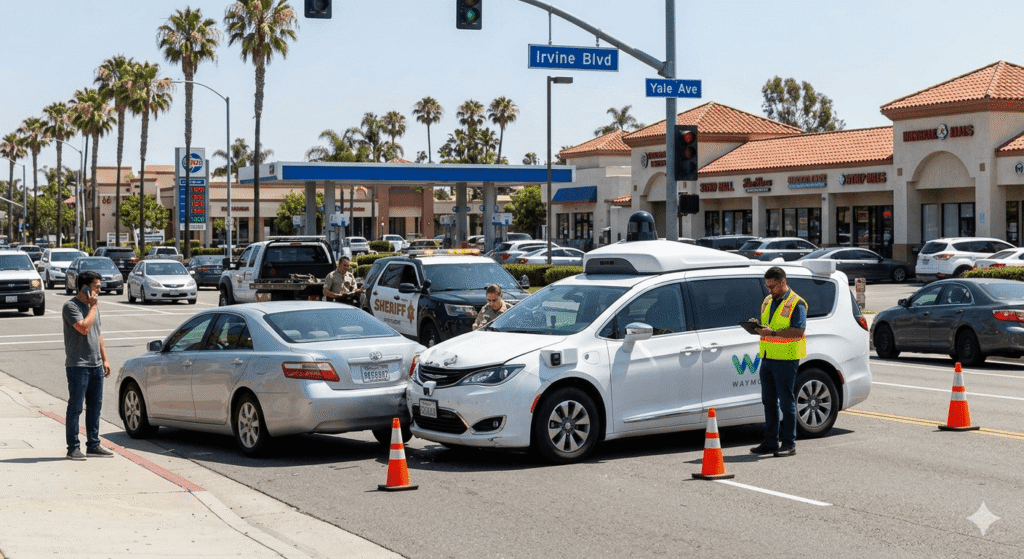
Self-driving vehicles are no longer experimental—they are actively being tested and deployed on California roads. Companies like Waymo are expanding operations across Southern California, which means Orange County residents may increasingly encounter autonomous vehicles in everyday traffic. If you have been injured in a Waymo self-driving car accident, you may be dealing with serious injuries, mounting expenses, and uncertainty about who is responsible.
Unlike a typical car accident, these cases are more complex. Instead of a single negligent driver, multiple parties may share responsibility. California law allows you to pursue compensation, but determining liability requires a detailed investigation into both human conduct and advanced vehicle technology.
How California Law Regulates Autonomous Vehicles
California has established a legal framework specifically for autonomous vehicles. California Vehicle Code § 38750 governs the testing and operation of these vehicles and authorizes the California Department of Motor Vehicles to issue permits and enforce safety standards.
The California Department of Motor Vehicles has also adopted regulations under California Code of Regulations, Title 13, § 227.00 et seq. and California Code of Regulations, Title 13, § 228.00 et seq. These rules apply to both testing and driverless deployment and require companies like Waymo to meet strict safety, reporting, and operational requirements.
These laws help define how autonomous vehicles must operate on public roads. If a company fails to follow these requirements, that failure may support a claim for negligence.
Who May Be Liable in a Waymo Accident
California law allows multiple parties to be held responsible for a single accident. California Civil Code § 1714 establishes that individuals and companies must use reasonable care to avoid causing harm.
In a Waymo accident, a human driver may still be liable. If another driver was speeding, distracted, or violated traffic laws, they may be partially or fully responsible.
Waymo or another company involved in the autonomous system may also be liable. If the vehicle’s software misinterpreted road conditions, failed to detect a hazard, or made an unsafe driving decision, that failure may create liability.
California follows a pure comparative fault system. Under California Civil Code § 1431.2, each party is responsible for non-economic damages based on their percentage of fault. This means you may still recover compensation even if more than one party contributed to the crash.
Product Liability and Self-Driving Technology
Product liability is often central in Waymo accident cases. California law allows injured individuals to pursue claims when a product is defective. These claims generally involve design defects, manufacturing defects, or failure to warn.
If the autonomous driving system itself is flawed, that may be considered a design defect. If a sensor, camera, or other component fails due to a manufacturing issue, that may also support a claim.
California Civil Jury Instructions (CACI) No. 1200 outlines the elements of strict product liability. You must generally show that the product had a defect, that you were harmed, and that this defect was a significant factor in causing your injuries.
These cases often require expert analysis. Engineers and accident reconstruction specialists may need to review vehicle data and system performance. Without legal guidance, it can be difficult to obtain and interpret this evidence.
Insurance and Compensation in California
California requires drivers and vehicle operators to carry insurance. California Vehicle Code § 16056 sets minimum liability coverage requirements, including $30,000 for injury to one person, $60,000 for injury to multiple people, and $15,000 for property damage.
Companies operating autonomous vehicles often carry higher insurance limits. This can be critical if your injuries are severe or long-lasting.
If you were injured, you may be entitled to compensation for medical expenses, lost income, and pain and suffering. California Civil Code § 1431.2 governs how non-economic damages are divided among multiple parties.
Time Limits and Legal Deadlines
If you were injured in a Waymo accident, you must act within California’s legal deadlines. California Code of Civil Procedure § 335.1 generally provides a two-year statute of limitations for personal injury claims.
If a government entity contributed to the accident, such as through a dangerous roadway condition, additional rules apply. California Government Code § 911.2 requires that a claim be filed within six months, and California Government Code § 945.4 generally requires that a claim be presented before filing a lawsuit.
Challenges Unique to Waymo Accident Claims
Waymo accident claims present challenges that are not found in traditional cases. One key issue is access to data. Autonomous vehicles generate detailed information, including sensor data, video recordings, and system logs.
This information can be critical to proving what happened, but it is often controlled by the company. Preserving and obtaining this evidence may require immediate legal action.
Another issue is determining whether the vehicle was operating in autonomous mode at the time of the crash.
Contact a Skilled Orange County Waymo Car Accident Lawyer
If a Waymo crash turned your life upside down in Anaheim, Irvine, Santa Ana, or elsewhere in Orange County, California, you deserve a top-rated trial team with a proven record of results. Law Offices of Samer Habbas & Associates has recovered more than $380,000,000 for injury victims and has earned recognition from Best Lawyers’ Best Law Firms, an Avvo 10.0 Superb rating, and selection among America’s Top 100 High Stakes Litigators. Our Orange County car accident lawyers have secured strong motor vehicle results, including an $865,000 rideshare recovery and a $1,000,000 rideshare settlement, demonstrating its ability to handle complex, high-stakes cases. Get Samer on Your Side—contact Law Offices of Samer Habbas & Associates by calling (888) 848-5084 or contacting us online for a free consultation.





 Should I Accept the First Settlement Offer After a Phoenix Car Accident?
  Free Consult
 Call 24/7