










62-Year-Old E-Bike Rider Killed in Huntington Beach Crash
Orange County Wrongful Death Rights & Legal Options | Samer Habbas & Associates, PC
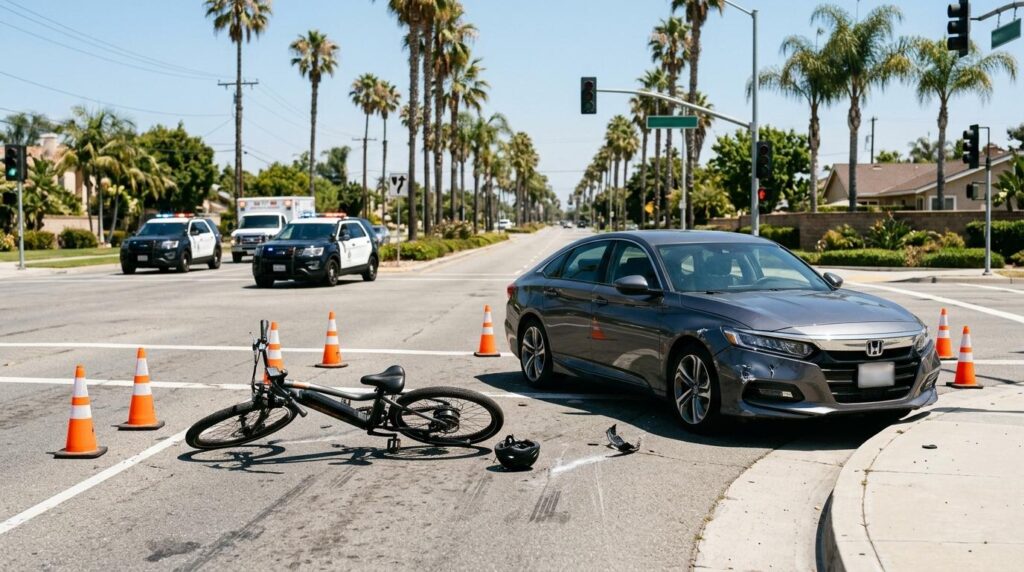
Have you suffered the unimaginable loss of a loved one in an Orange County bicycle or electric bike collision? A tragic late-afternoon crash in Huntington Beach has claimed the life of a 62-year-old woman who was riding her electric bicycle in a designated bike lane along Warner Avenue. At the Law Offices of Samer Habbas & Associates, PC, our hearts go out to the victim’s family, friends, and the Huntington Beach community mourning this sudden and devastating loss. When a routine ride in a marked bike lane turns fatal, surviving family members are left grappling with profound grief, unanswered questions, and unexpected financial burdens. We will guide you through the legal process and fight for you and your family to get the justice and full compensation you deserve.
Under California law, even when preliminary news snippets only capture a fraction of what happened at the scene, families of cyclists and e-bike riders killed on public roadways have powerful legal protections. Consulting an experienced Anaheim Bicycle Accident Lawyer and a dedicated Anaheim Wrongful Death Lawyer early in the investigation is essential to uncovering the full truth. Under California Code of Civil Procedure (CCP) § 377.60, eligible surviving family members have the right to pursue a wrongful death claim when another party’s negligence, a commercial vehicle hazard, or a dangerous roadway condition contributes to a fatal crash. Because California imposes strict filing deadlines—including a general two-year statute of limitations under CCP § 335.1 and an urgent six-month deadline for government road defect claims under California Government Code § 911.2—acting quickly to preserve physical and digital evidence is critical.
About the Huntington Beach Fatal E-Bike Crash
According to reports published via Google News and local broadcast outlet KTLA, officers from the Huntington Beach Police Department (HBPD) responded to a severe collision at the intersection of Warner Avenue and Brightwater Drive on October 17 at approximately 4:30 p.m. First responders arrived on the scene to find a 62-year-old woman who had suffered catastrophic, life-threatening injuries while riding an electric bicycle. Despite emergency medical intervention, the woman tragically succumbed to her injuries.
Based on preliminary statements from the Huntington Beach Police Department, the 62-year-old rider was traveling lawfully inside the designated bicycle lane on Warner Avenue when the collision occurred at or near Brightwater Drive. In the immediate aftermath of a fatal bicycle or e-bike crash, preliminary media summaries often note only that a cyclist “struck” a vehicle or object—language that rarely tells the whole legal or forensic story. When the deceased rider is no longer here to give their account of the crash, initial police narratives may rely heavily on the statements of surviving motorists or incomplete roadside observations before the HBPD Multidisciplinary Accident Investigation Team (MAIT) completes a full forensic reconstruction.
The intersection of Warner Avenue and Brightwater Drive sits in northwestern Huntington Beach, just east of the Bolsa Chica Ecological Reserve and Pacific Coast Highway. Around 4:30 p.m., this coastal arterial corridor experiences heavy late-afternoon commuter traffic, beachgoers departing the coast, delivery vehicles, and residential traffic turning into and out of the Brightwater neighborhood. In bike-lane collisions of this nature, thorough independent investigations frequently reveal critical underlying causes, including:
- Motorists encroaching into or obstructing the bicycle lane: Under California Vehicle Code (CVC) § 21209, motor vehicles are strictly prohibited from driving, stopping, or parking in a designated bicycle lane except under narrow, regulated circumstances (such as preparing for a lawful turn within 200 feet of an intersection after yielding to cyclists).
- “Right-hook” or “left-cross” turning violations: Drivers turning right onto Brightwater Drive from Warner Avenue—or pulling out of Brightwater Drive onto Warner Avenue—frequently fail to check their mirrors or blind spots for faster-moving electric bicycles approaching in the bike lane, violating right-of-way mandates under CVC § 21717 and CVC § 21800.
- Sudden lane intrusions, parked vehicles, or “dooring” hazards: Under CVC § 22517, no person shall open the door of a vehicle on the side available to moving traffic unless it is reasonably safe to do so and can be done without interfering with the movement of other traffic, including bicyclists. Similarly, illegally stopped commercial trucks, landscaping trailers, or passenger cars blocking a bike lane can create a sudden trap for a rider.
- Sightline obstructions and late-afternoon sun glare: At 4:30 p.m. in mid-October, the sun sits low on the western horizon directly down the east-west trajectory of Warner Avenue, creating severe blinding glare that can impair both drivers and riders if proper roadway engineering and traffic controls are absent.
When a fatal collision involves a motor vehicle interaction, our legal team also brings decades of perspective as a trusted Anaheim Car Accident Lawyer to examine vehicle telemetry, braking data, cell phone records, and right-of-way violations that transform how liability is understood.
Why Warner Avenue and Orange County Roads Are So Dangerous for E-Bike Riders and Cyclists
Orange County’s coastal cities—especially Huntington Beach, Newport Beach, Costa Mesa, and Seal Beach—have experienced an explosion in electric bicycle adoption among residents of all ages. While e-bikes provide clean, accessible transportation along coastal corridors, local roadway infrastructure has frequently failed to keep pace. According to data from the National Highway Traffic Safety Administration (NHTSA) and the California Office of Traffic Safety (OTS), California consistently leads the nation in bicyclist fatalities, and Orange County ranks among the state’s highest counties for severe and fatal bicycle and e-bike crashes—particularly among adults aged 55 and older.
Warner Avenue is a wide, high-speed multi-lane arterial road that carries thousands of vehicles daily between Interstate 405, Huntington Harbour, and Pacific Coast Highway. Despite being heavily used by cyclists and e-bike riders traveling toward the coast and local residential enclaves like Brightwater, corridors like Warner Avenue present acute structural hazards:
- Unprotected painted bike lanes next to high-speed traffic: A thin strip of white paint offers zero physical protection when passenger vehicles, SUVs, and commercial trucks travel at 45 to 55+ mph just inches away.
- High-conflict residential and commercial driveways: Where side streets like Brightwater Drive intersect major arterials without dedicated bicycle signal phases or protected intersection islands, vehicles turning across the bike lane create lethal conflict points.
- Speed perception gaps with e-bikes: Under California Vehicle Code § 312.5, Class 1 and Class 2 e-bikes provide assistance up to 20 mph, while Class 3 e-bikes assist up to 28 mph. Motorists frequently misjudge how quickly an e-bike is approaching in the bike lane and pull out or turn directly into the rider’s path, leaving the rider no time or stopping distance to avoid impact.
- Pavement defects, debris, and drainage grates: Uneven asphalt seams, utility trenching, sand blown from coastal zones, or poorly maintained gutter pans inside the bike lane can destabilize a two-wheeled e-bike or prevent effective emergency braking.
When a roadway’s layout, lack of physical buffering, inadequate signage, poor sightlines, or pavement deterioration creates a substantial risk of injury even when used with due care, the government agency responsible for the road may share legal accountability under California Government Code § 835 for maintaining a dangerous condition of public property.
California Wrongful Death Law: What Families of Fatal E-Bike Accident Victims Can Recover
When an electric bicycle rider loses their life due to negligence in Orange County, California law provides two distinct but complementary civil legal actions that frequently proceed together: a Wrongful Death Claim and a Survival Action.
1. Wrongful Death Claims (California Code of Civil Procedure § 377.60)
A wrongful death lawsuit under CCP § 377.60 belongs directly to the decedent’s surviving statutory heirs—typically the surviving spouse or registered domestic partner, children, and the issue of deceased children (or other dependent family members as defined by the statute). This claim compensates the family for the losses they suffer as a result of their loved one’s death, divided into economic and non-economic damages:
- Economic Damages: The financial support the decedent would have contributed to the family during their life expectancy; the loss of gifts or benefits the family would have expected to receive; funeral and burial expenses; and the reasonable dollar value of household services the decedent would have provided.
- Non-Economic Damages: Compensation for the profound human loss of the decedent’s love, companionship, comfort, care, assistance, protection, affection, society, moral support, and (for a surviving spouse or partner) the loss of intimacy and consortium. Critically, California places no arbitrary statutory cap on non-economic wrongful death damages in motor vehicle, bicycle, or roadway negligence cases.
2. Survival Actions (California Code of Civil Procedure § 377.30)
Unlike a wrongful death claim, a survival action under CCP § 377.30 is brought by the decedent’s personal representative (or successor in interest) on behalf of the deceased person’s estate for claims the victim could have pursued had they survived the crash. Under CCP § 377.34, recoverable damages in a survival action can include:
- Emergency Medical and Ambulance Bills: All hospital, paramedic, and trauma care expenses incurred between the moment of injury and the time of death.
- Pre-Death Pain, Suffering, or Disfigurement: Where supported by the evidence and applicable statutory provisions, damages for the conscious physical pain, fear, and emotional distress the victim experienced between the impact and their passing.
- Property Damage: Replacement value of the destroyed electric bicycle, helmet, personal electronics, and gear.
- Punitive Damages: Unlike a standard wrongful death claim, a survival action allows the estate to pursue punitive and exemplary damages under California Civil Code § 3294 if the at-fault party acted with malice, oppression, or conscious fraud (such as a drunk, drugged, or fleeing hit-and-run driver).
Who Can Be Held Liable When an E-Bike Rider Is Killed?
Fatal e-bike crashes are rarely as one-sided as an initial two-sentence news brief suggests. At Samer Habbas & Associates, PC, we investigate every potentially responsible party to ensure our clients have access to all available insurance policies and corporate or municipal assets.
The Other Driver
Whether a motorist made an unsafe turn across the Warner Avenue bike lane, stopped illegally inside the bicycle lane, pulled out from Brightwater Drive without yielding, drifted over the bike lane stripe while distracted, or opened a car door into traffic, driver negligence is the leading cause of fatal cycling collisions. In addition to the driver’s personal liability:
- Vehicle Owner Liability (California Vehicle Code § 17150): Under CVC § 17150, the registered owner of a motor vehicle is vicariously liable for death or injury resulting from a negligent or wrongful act or omission in the operation of the vehicle by any person using it with the owner’s express or implied permission. Moreover, if the owner negligently entrusted the vehicle to an unfit, unlicensed, or reckless driver, the owner faces full independent liability.
- Commercial Employer Liability (Respondeat Superior): If the vehicle involved was a delivery van, rideshare car, utility truck, landscaping vehicle, or company car operating within the course and scope of employment, the employer is legally responsible under California’s doctrine of respondeat superior, unlocking high-limit commercial insurance policies.
- DUI and Reckless Driving (Punitive Damages): If the motorist was driving under the influence of alcohol or drugs or engaging in egregious street racing or reckless conduct, the family may pursue punitive damages via a survival action to punish the wrongdoer.
Government Entities — Road Defect Cases
Local and state agencies—such as the City of Huntington Beach, the County of Orange, or the California Department of Transportation (Caltrans)—owe a duty to keep public streets and bike lanes free of concealed traps and hazardous configurations. Under California Government Code § 835, a public entity can be held liable if:
- The public property (such as the Warner Avenue bike lane or the Brightwater Drive intersection) was in a dangerous condition at the time of the crash;
- The dangerous condition was a proximate cause of the fatal injury;
- The dangerous condition created a reasonably foreseeable risk of the kind of crash that occurred; and
- Either a negligent or wrongful act of a public employee created the condition, or the public entity had actual or constructive notice of the dangerous condition a sufficient time prior to the injury to have taken protective measures.
Crucial Deadline Warning: Under the California Government Claims Act (California Government Code § 911.2), a formal administrative tort claim must be filed with the responsible government entity within six (6) months of the date of the fatal crash. Missing this six-month window can permanently bar a family from suing the city, county, or state.
Defective Products / Manufacturers
Electric bicycles are heavier and travel at higher sustained speeds than traditional pedal bicycles, placing immense demands on braking systems, tires, forks, frames, and electronic motor controllers. Under California’s strict products liability laws, if an e-bike rider was unable to stop or steer away from a hazard because of a defective hydraulic or mechanical disc brake, a sticking throttle or pedal-assist sensor that continued propelling the bike forward, a sudden front fork fracture, or a motorVehicle collision mitigation system failure in the automobile involved, the manufacturer, distributor, and retailer can be held strictly liable for the resulting fatality.
California’s Comparative Fault System
One of the most important reasons families should never accept an initial police summary or an insurance adjuster’s denial at face value is California’s pure comparative fault rule. When preliminary reports mention that an e-bike rider “struck” a vehicle, insurance companies immediately try to blame the deceased cyclist to avoid paying a claim.
In states with harsh “contributory negligence” or “modified 50% bar” laws, being found 50% or more at fault completely eliminates a family’s right to recover a single dollar. California law is fundamentally different. Under California’s pure comparative negligence system (established by the California Supreme Court in Li v. Yellow Cab Co.), fault is apportioned on a percentage basis among all responsible parties, and a victim’s family is never barred from financial recovery simply because the victim may have shared partial responsibility—even if the rider were found 50%, 70%, or 80% at fault.
For example, suppose a driver illegally parked or stopped a vehicle partially inside the Warner Avenue bike lane or made an improper turn at Brightwater Drive, and the defense argues the e-bike rider should have braked sooner. If total wrongful death damages equal $3,000,000 and a jury finds the motorist/roadway 75% at fault and the rider 25% at fault, the family is still entitled to recover $2,250,000 (75% of the total award). Furthermore, once our accident reconstruction experts analyze stopping distances, human perception-reaction times, and sightline obstructions, we frequently prove that the cyclist acted reasonably in a sudden emergency and bore zero fault for the collision.
Statute of Limitations: Don’t Wait to Protect Your Family’s Rights
In the wake of a sudden death, filing a lawsuit is often the last thing a grieving family feels ready to confront. However, California law enforces unforgiving legal deadlines, and crucial physical evidence at the crash scene vanishes within days:
- Two-Year Wrongful Death Statute of Limitations (CCP § 335.1): Under California Code of Civil Procedure § 335.1, families generally have two (2) years from the date of their loved one’s death to file a civil lawsuit for wrongful death and survival claims against private individuals and corporations.
- Six-Month Government Claim Deadline (California Government Code § 911.2): If any public entity (such as the City of Huntington Beach, Orange County, a public transit agency, or Caltrans) contributed to the crash through a dangerous intersection design, defective bike lane, obscured signage, or involvement of a municipal vehicle, you must file a formal administrative claim within six (6) months of the incident.
Beyond legal deadlines, early intervention is vital for evidence preservation. Security and doorbell cameras from homes along Brightwater Drive, dashcam footage from commuters on Warner Avenue, and commercial surveillance systems often overwrite their hard drives within 7 to 14 days. Skid marks fade, vehicles are repaired, and the electric bicycle itself must be secured and inspected by forensic engineers before it is altered or discarded.
What Samer Habbas & Associates, PC Does When We Take a Wrongful Death Case
Led by Founder and Managing Attorney Samer Habbas (California State Bar #243683), our firm has spent more than two decades fighting for injured victims and bereaved families across Orange County and Southern California. When you entrust your family’s wrongful death case to the Law Offices of Samer Habbas & Associates, PC, we mobilize immediately:
- Immediate Scene & Forensic Investigation: We dispatch investigators to the intersection of Warner Avenue and Brightwater Drive to photograph lane markings, measure sightlines at 4:30 p.m. lighting conditions, canvass nearby residences and businesses for surveillance video, and locate independent eyewitnesses.
- Evidence Preservation & Spoliation Letters: We issue formal legal preservation demands to all involved drivers, vehicle owners, commercial fleets, and municipal agencies requiring the preservation of vehicle Event Data Recorders (“black boxes”), cell phone logs, dashcam video, and the e-bike’s mechanical and electronic components.
- World-Class Accident Reconstruction & Biomechanical Experts: We retain leading forensic engineers, bicycle traffic safety specialists, and human-factors experts to reconstruct speed, visibility, perception-reaction times, and vehicle positioning.
- Protective Government Tort Filings: We prepare and file comprehensive administrative claims under Government Code § 911.2 well within the six-month deadline whenever roadway geometry, bike lane maintenance, or traffic controls may have played a role.
- Relentless Negotiation & Trial Advocacy: Insurance companies know our reputation. With our slogan—“Hundreds of Millions Recovered & Counting”—backed by real courtroom strength, we prepare every wrongful death case as if it is going to trial.
Our commitment to our clients is reflected in our track record of $380,000,000+ Total Recovered for clients over our firm’s lifetime, including landmark results such as:
- $11,000,000 — Top single case result
- $4,007,015.24 — Notable settlement
- $3,450,000 — Notable settlement
- $2,675,000 — Notable settlement
- $2,500,000 — Notable settlement
- $2,250,000 & $2,000,000 — Multiple major recoveries for seriously injured victims and families
View our full case results to see how our trial attorneys fight for maximum recovery across Southern California.
Frequently Asked Questions — Fatal E-Bike and Bicycle Accidents in California
1. Who can file a wrongful death lawsuit after a fatal e-bike crash in California?
Under California Code of Civil Procedure § 377.60, the primary parties entitled to file a wrongful death claim are the deceased victim’s surviving spouse, registered domestic partner, children, and the children of any deceased child of the victim. If there are no surviving descendants, the claim may be brought by individuals who would be entitled to the property of the decedent by intestate succession (such as parents or siblings). Additionally, putative spouses, stepchildren, parents, or minor household residents who were financially dependent on the decedent may also have standing to sue.
2. How long does our family have to file a fatal e-bike accident claim in Orange County?
For claims against private motorists, vehicle owners, or product manufacturers, you have two (2) years from the date of death under CCP § 335.1. However, if a city, county, or state government agency is partially responsible—for example, due to a dangerous bike lane design or road hazard on Warner Avenue—you must file a formal administrative claim within just six (6) months under California Government Code § 911.2. Consulting an attorney immediately ensures no deadline is missed.
3. What if the initial news report or police report says the e-bike rider struck the vehicle or was partially at fault?
Do not assume your family lacks a valid case. First, preliminary police statements and short news briefs are not final determinations of civil liability and are generally inadmissible as ultimate conclusions in court. Often, a driver unlawfully turns across or stops inside a bike lane, leaving the cyclist no way to avoid hitting the vehicle. Second, under California’s pure comparative fault rule, your family can still recover substantial compensation even if the rider is assigned a percentage of fault.
4. What if the driver who caused the crash fled the scene or had minimal insurance?
If the crash involved a hit-and-run driver or an uninsured/underinsured motorist, your family may still recover significant compensation through the deceased victim’s own Uninsured/Underinsured Motorist (UM/UIM) auto insurance policy—or the UM/UIM policy of a resident relative in the same household. In California, standard UM/UIM auto coverage follows the insured person even when they are riding a bicycle or electric bike rather than driving a car.
5. What is the difference between a California wrongful death claim and a survival action?
A wrongful death claim (CCP § 377.60) compensates surviving family members for their own losses—such as lost financial support, funeral costs, and the loss of their loved one’s love, companionship, and guidance. A survival action (CCP § 377.30) is brought on behalf of the deceased victim’s estate to recover losses the victim suffered prior to passing away, including emergency medical bills, pre-death pain and suffering, destroyed personal property, and potential punitive damages.
6. How much does it cost to hire Samer Habbas & Associates, PC for a wrongful death case?
There are zero upfront costs to hire our firm. We handle all wrongful death and bicycle accident cases on a contingency fee basis—meaning we advance all investigation, court, and expert witness expenses, and you pay no attorney’s fees unless and until we win compensation for your family.
7. Should our family speak to the other party’s insurance adjuster?
No. Insurance adjusters are trained professionals whose primary goal is to minimize the company’s payout by obtaining recorded statements, shifting blame onto the deceased e-bike rider, or pressuring grieving families into quick, inadequate settlements before the full scope of liability is investigated. Direct all insurance inquiries to your attorney at Samer Habbas & Associates, PC so we can protect your rights.
Contact Samer Habbas & Associates, PC After a Fatal E-Bike Accident
Hundreds of Millions Recovered & Counting — Let Our Family Fight for Yours
Have you suffered an injury from an accident or lost a loved one in an Orange County e-bike or bicycle crash? We will guide you through the process and fight for you & your family to get the compensation and accountability you deserve. Our compassionate legal team is available 24/7 to provide a confidential, zero-obligation case evaluation. With $380,000,000+ recovered and our No Fee Unless We Win guarantee, you pay nothing upfront.
CALL NOW FOR A FREE CASE REVIEW: 888-848-5084
FREE CASE REVIEW — GET HELP NOW
Primary Orange County Office (Irvine):
Law Offices of Samer Habbas & Associates, PC
200 Spectrum Center Dr, Suite 1230, Irvine, CA 92618 | Local Phone: (949) 379-1424
Anaheim Office: 2099 S State College Blvd, Suite 460, Anaheim, CA 92806 | Local Phone: (714) 786-1404
El Segundo Office: 1730 E Holly Ave, Suite 752, El Segundo, CA 90245
Website: https://www.habbaspilaw.com | Email: info@habbaspilaw.com
 Victims Killed in Catalina Island Helicopter Crash Identified
 Free Consult
 Call 24/7